This blog is authored by Mieke Snijder and Brigitte Rohwerder.
This is the second blogpost in our series on “Exploring participatory methods for individual and collective healing” that has resulted from a workshop with IDS participatory researchers. In this blogpost we will discuss four ways in which we think participatory methods can facilitate healing.
Participatory methods support participants to express themselves, together
Participatory research is a collective effort in which participants are brought together to become co-researchers and agents of change in their communities. Through creative participatory methods participants are allowed to express themselves and share things about their lives they haven’t shared before with other people. It gives them an opportunity to step back and reflect on what is going on for them.
We have seen this come up in our research with children in the worst forms of child labour, where children were invited to share and analyse their life stories and they reflected they were sharing things they hadn’t even told their parents. Similarly, research with young people in conflict zones in Zimbabwe that used theatre and drawing saw that the young people really jumped at the opportunity to express themselves.
In a Photovoice project with Aboriginal youth in Australia, participants were invited to take photos of things they liked about where they live and activities they do with their friends. This participatory and asset-based approach helped the students to reflect on what is good in their lives, which gave them hope for the future:
“This built our inner strength that we can draw on for the future”
– Project participant
Given the collective nature of participatory methods, it’s not just about sharing our own stories, but equally important is hearing other people’s stories. By hearing other people’s stories, we can start to understand that we are not alone in our experiences and identify that others are ‘different in a similar way’, which is part of a healing journey.
Participatory methods can build collective solidarity and identity
This understanding that we are not alone in our experiences is the starting point of how participatory methods build collective solidarity and identity. Building collectives is an essential part of healing, given the dividing nature of trauma and of the traumatising systems we live in. Whilst undertaking embodied participatory research on embodying everyday peace we witnessed Yazidi women building collective solidarity whilst sharing their experiences of living under conflict. Similarly, in research with women with disabilities and rural young people in the Kurdistan Region of Iraq, sharing and collectively analysing their experiences of social assistance provision, highlighted a key issue they shared was the lack of dignity experienced as a result of photos being taken of them when they went to receive assistance, which were then posted on social media.

Knowing this was a shared problem helped them develop a common purpose as the basis for group action around the “Protect my dignity” campaign.
“I liked every activity, and creative work, that we’ve done here so far – especially hearing about other people’s stories, because… I found that I’m not the only one… suffering through the issues… and we can connect to each other more that way.”
– (Participatory discussion, in Shaw et al, 2024)
In our work analysing children’s life stories with children in the worst forms of child labour in Bangladesh and Nepal, many of the children reflected that hearing other children’s stories made them more empathic towards their peers and motivated them to act together to change their circumstances. In the resulting action research groups, the children were able to build a collective identity through the process of collectively analysing their circumstances and planning and taking actions. This collective identity resulted in the group becoming a ‘new actor’ in the context who implemented innovative actions to tackle the drivers of the worst forms of child labour.
When using participatory methods, we also need to critically consider who the community is, acknowledge that there might be conflict between community members and that there is a risk of contributing to existing tensions. For example, when working with Aboriginal Australians, there are often factions within geographical communities due to the colonial practice of moving different Aboriginal family groups into one ‘mission’.
In a community-based participatory research project in Australia, we started from a wrong understanding of ‘community’ and naively only engaged with one Aboriginal family group in the geographical location, which contributed to tensions related to the work. We realised that intergenerational trauma prevented the community from coming together. To resolve this, we worked closely with each of the groups separately to organise cultural, sports and empowerment activities. Over time the groups started coming closer together and made connections across.

Participatory methods can reconfigure relationships
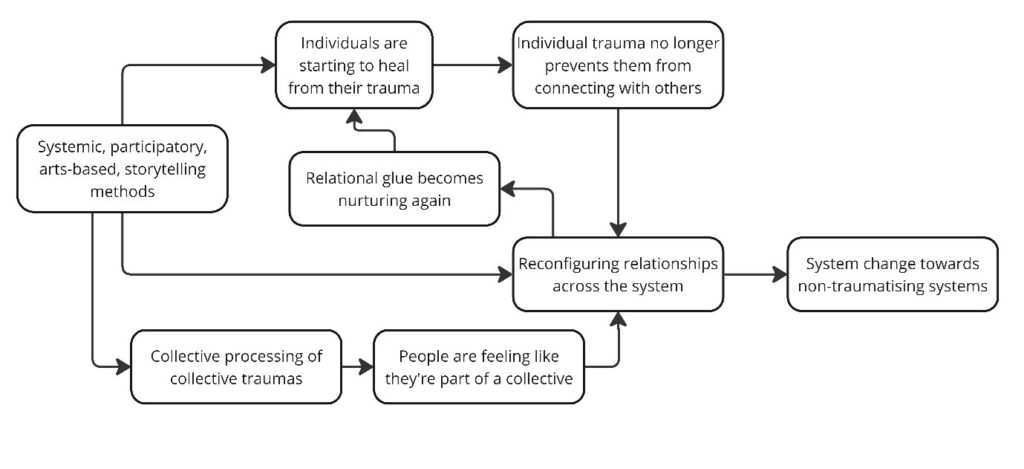
Participatory methods have the potential to reconfigure relationships amongst actors in the system and change community connections. Our work on Systemic Action Research for peacebuilding, for example, explored the relational dimension of system change, in which we found evidence that by participating in the action research processes, community members were able to repair relationships.
Similarly, in Systemic Action Research on child labour we identified that business owners moved from being competitors to becoming collaborators in addressing the worst forms of child labour in their sector. Similarly, children were able to connect with each other in ways they had not had the opportunity before. These reconfigured relationships can reduce the likelihood of further trauma that result from fractured relationships and, when individuals are healing from their traumas it opens up pathways to build stronger relationships (as it no longer prevents people from being able to connect with others – see Figure below).
Reflexive practice in participatory methods allow facilitators to reflect on our own need to heal
As facilitators of participatory research, we do not separate ourselves from our research, but we bring our full selves to it. This requires a reflexive practice, where we take time to reflect on how our own experiences influence how we do the work and connect with others. This includes reflecting on our own brokenness. Reflecting on our experiences of living in oppressive systems of patriarchy, racism, colonialism and increasing violence and militarism worldwide, as well as within the European context. And reflecting on how we make sure we do not subconsciously perpetuate these systems in our facilitation. Working with participatory methods allow us to not just talk about the need to heal for others, but acknowledge that we all live in an interconnected web of beings and that my healing is dependent on everyone else’s healing: I am because you are. This reflexive practice is a key part of our work as participatory researchers.