Systemic Action Research on marginalisation in Gateshead, UK
This case study examines a Systemic Action Research inquiry into the interlocking issues creating marginalisation in neighbourhoods in Gateshead, a town near the northern city of Newcastle in the UK.
Convened by the Lankelly Chase Foundation (the funder) and the Institute of Development Studies (providing methodological support), the purpose of the project was:
- to surface and interrogate the systemic drivers of marginalisation in Gateshead;
- to identify potential pathways and actions for change; and
- to strengthen networks such that collective, relationship centred actions could shift the local system toward inclusion and equity.
Lankelly Chase Foundation (LCF) and IDS convened at the outset with seven small community-based organisations (CBOs) working with specific groups (for example, refugees and asylum seekers, people in recovery, young women who have experienced violence, young fathers, and people experiencing mental health challenges).
Over four years, 110 stories were subsequently collected and analysed by a trained cohort of 14 community researchers, and multiple Action Research Groups (ARGs) were formed, ultimately consolidating to three focus areas in the second phase.
What happened
LCF and IDS proposed a participatory, story-led inquiry. Each CBO nominated link workers—peers with lived experience—to be trained in research principles, ethics, and storytelling and to collect narratives that could be collectively analysed for causal patterns.
Link workers were trained to collect life stories from people in their networks, using simple prompts to elicit their experience of living in the area, with deepening prompts to dig into causes and consequences. Following a year of story collection and practice analysis, link workers and some storytellers convened in 2021 to analyse 110 stories and build a system map, extracting causal factors and mapping positive (red) and negative (black) pathways on a large, cumulative system map, with lines thickened to show frequency across the stories.
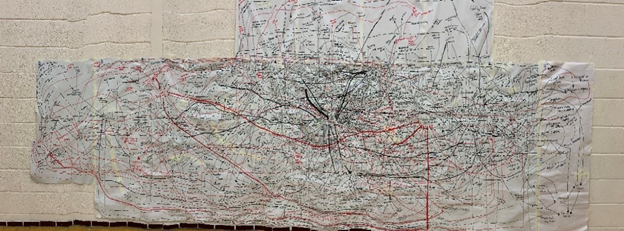
This visual systems analysis enabled the group to recognise shared drivers and possibilities for action. They selected key themes and pathways to establish the ARGs. Each ARG centred the knowledge and agency of those experiencing marginalisation, to inquire further and act.
The ARGs met weekly or fortnightly, rotating facilitation to build confidence while relying on the coordinator for continuity, and pursued both inward-facing (solidarity, confidence, belonging) and outward-facing (engagement with service providers) actions, with strongest external traction reported in the isolation/asylum seeker group. The ARGs rotated facilitation and prioritised mutual care, including trauma-informed pauses and embodied exercises when analysis surfaced difficult emotions.
The project adapted in response to different challenges:
- During 2020 and the Covid pandemic, work paused and moved online, requiring changes to training, convening, and support.
- At the end of phase one, the organisastion-based link worker role was rethought so that it would connect into the work evolving through the relational grassroots. Thus, the peer enabler role was introduced, and Bridgebuilders were recruited and sometimes drawn from existing link workers to knit the work across groups and decision spaces.
- Over time, the initial seven ARGs were reduced to three, to find sharper purchase on actionable themes. Groups whose remit skewed toward service improvement (for example, “improving mental health services”) struggled to sustain inquiry and drifted back to organisational remits. Another group struggled with continuity due to members’ personal circumstances. The surviving groups iterated to more feasible scopes (for example, isolation among asylum seekers in hotel accommodation, an “adulting” peer space for young people, and community-based support for people awaiting NHS mental health services).
Findings and new knowledge
The action research was anchored in a deeply participatory process, supported by a skilled local coordinator with strong relational and facilitation skills. Participatory methods worked well because knowledge creation was anchored in lived experience, participants recognised themselves in the analysis, felt valued, and built the agency to act. The sociality of mapping—reading stories together, drawing causal links, revisiting themes—made systemic patterns visible and actionable while strengthening relationships that are themselves levers of change.
Visual analysis revealed common causal factors across diverse experiences, enabling participants to resituate “my story” within broader systemic patterns. By quantifying recurrence visually (line thickening), participants could prioritise leverage points and design interventions at both the relational and pathway levels.
Participatory analysis shifted blame/shame to structural understanding, catalysing confidence, empathy, and a sense of common cause—preconditions for collective action. Trust grew in a nonlinear way through regular meetings, fun activities, and commitments honoured (or not).
Intentional networking inside the ARGs and with external actors (for example, the company operating the asylum hotel) began to reconfigure local relationships, opening new channels for dialogue and practical problem solving.
The process contributed to participation and intentional networking across communities experiencing marginalisation; it strengthened individual confidence and collective efficacy; and it seeded practical changes in how certain local institutions (notably the asylum hotel operator) engaged with residents.
The isolation group engaged with service providers as well as asylum seekers, and the group expanded as a space for refugees and asylum seekers to build their confidence and skills:
‘I can now do other things, speak up for myself, my confidence in the group has led to more confidence in other areas of my life, and to become a voice for others, to support others’ (isolation AR group, Gateshead).
For the young people’s group and the mental health group, the action remained more at the level of the group. They saw the group as a space of belonging and solidarity, and of meaningful conversations:
‘Someone might raise something they’re going through and someone else has been through it, and these shared experiences are key, we can be talking about nothing and suddenly it’s about something really important’
(young people’s ‘adulting’ group, Gateshead).
These internal shifts have led to the construction of an alternative narrative about themselves in relationship to others in the community.
Many of these initiatives are continued through a new iteration of the work, the Gateshead Community Bridgebuilders.
Lessons
A very wide system focus made it harder for some ARGs to gain traction, leading to drift toward familiar organisational remits, or inactivity.
- Groups working with young people and those with significant life challenges faced attendance and follow through issues, which affected trust trajectories and momentum.
- While internal benefits (confidence, solidarity) were strong, outward change varied by theme, with the asylum seeker strand achieving more visible engagement than others.
- Very broad problem frames and thin facilitation capacity can dilute inquiry and stall action.
This approach (Systemic Action Research) may not work well where groups are tightly bound to improving existing services rather than inquiring into causes and relationships, participatory systemic work risks being displaced by delivery imperatives.
This work was possible because of the open and flexible approach of the funder, which was committed to understanding and addressing systems, and not symptoms, of injustice. They allowed the work to grow at its own pace, outside of projectised timescales, and funded a coordinator to support the work. His accompaniment and championing of the process allowed the participants to grow in confidence, and catalysed wider relationship building which has secured the longevity of the work.
In terms of ethical considerations, in immersing themselves in the stories, people became emotional as they read about others’ experiences of discrimination, hardship and sometimes abuse. This required taking a pause: the group discussed how to manage this and came up with ways to support each other. For example, those with trauma-informed training introduced embodied exercises. The group was able to move forward with a sense of mutual care and acknowledgement of different experiences, knowledge and needs.
An ethics review was undertaken and approved by IDS, taking into consideration and establishing protocols for ensuring consent, confidentiality and safeguarding. Further training and support was regularly provided by the coordinator, and this iterative attention to ethics is fundamental to good practice and care in participatory processes with marginalised groups.