Our experience in Disability Inclusive Early Childhood Development and Education in Kenya
This post was authored by Josephine Njungi.
Knowledge development and curation, in process, outcome and ownership, is filled with power. Participatory research was adopted to address this, as this way of research enables and empowers people and groups of people to play an active and influential role in research that affects their lives.
A recent issue of the IDS Bulletin explored how the Disability Inclusive Development Inclusive Futures (DIDIF) Programme was implemented in Kenya, Nepal, Tanzania, Uganda, Nigeria and Bangladesh. One of the papers focuses on the experiences of implementing participatory research as part of the programme, including reflections on power and positionality. This blog reflects on those experiences in Kenya as part of a participatory research project exploring disability inclusive early childhood development and education using peer researchers.
Who was involved:
The team included eight peer researchers with disability from Homabay (western Kenya) and Kakuma (northern Kenya), a Nairobi based researcher and two UK based researchers. The requirements to be a peer researcher were flexible. The key requirements were that they were persons with disability or a caregiver to someone with disability, that they had some community facilitation experience, and they resided in the programme areas.
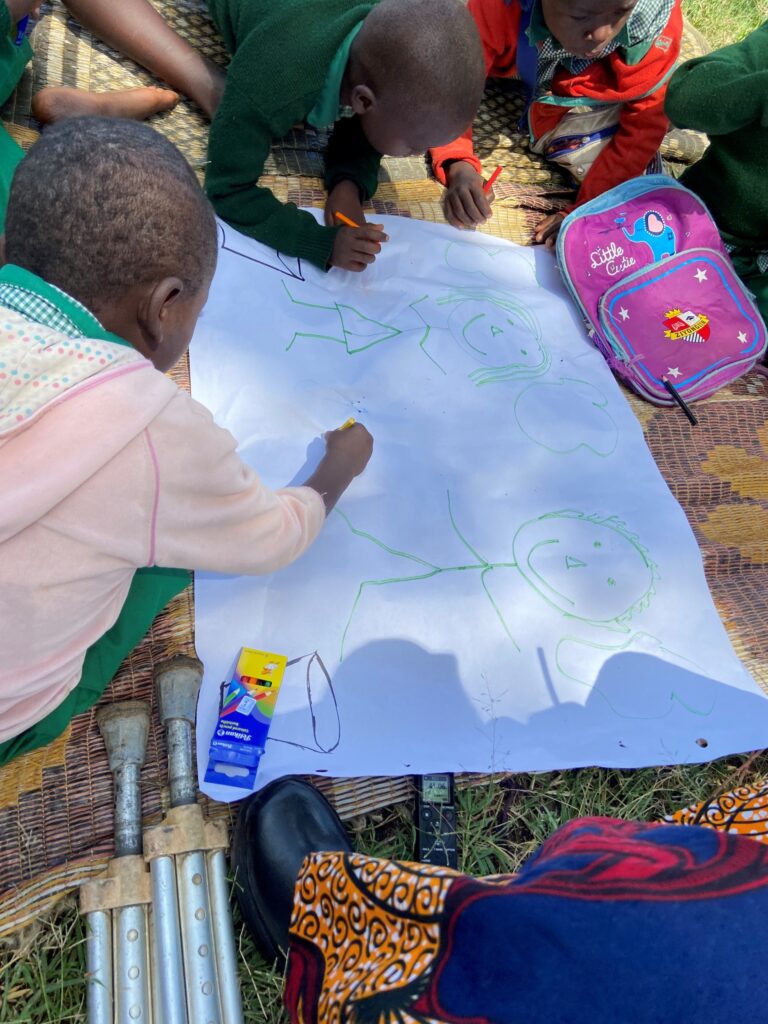
Credit: Josephine Njungi, Director Strategy & Planning, Research PLUS Africa
Reflecting on our positionality
In some participatory research processes, peer researchers may share similar experiences, backgrounds, identities, social and geographical positions, education levels among other things. In this instance, there were connections and disconnections in the same aspects. While there were similarities in engaging in the disability movement, eight were persons with disability, who lived in the areas of study; seven had graduate degrees while the others had technical education; one was retired; and three are researchers.
To make sure we were aware of how our identities influenced the research process and to ‘flatten’ these disparities we modelled respect, affirmed each other and appreciated everyone’s contributions. You may ask, how did we do this? Here are some tips for you from our experience of flattening these disparities: :
- Select a safe and accessible space to deliver training to peer researchers:
We did this at OPD offices where the peer researchers felt comfortable and spaces were accessible. - Allocate ample time to the research process:
You can’t rush the training and everyone needs to be on the same page with regards to data collection and analysis. Patience is needed to allow both peer researchers and participants to fully express themselves. - Check and then crosscheck all materials to be used in the research process for accessibility:
This is an essential step towards inclusivity. Make use of technology where appropriate to share thoughts, insights and impressions of conversations and data. - Clarify roles from the beginning and give everyone a chance to input on their role:
Peer researchers must be encouraged to feel comfortable with agency in leading the groups. In our experience, it is really important that participants looked at the peer researchers as the default owners of the process and data resulting from the discussions. In this way, peer researchers became regarded as positive role models for participants. In particular, the Nairobi-based researcher served as trainer and note taker for the groups. Even though they were a seasoned researcher, this was the right role. Their managed visibility in the groups served to ensure that the peer researchers were comfortable and with agency in leading the groups. The groups ran with minimal interruptions. This ensured that parents, children and teachers referred and looked at the peer researchers as the default owners of the process and data resulting from the discussions. This had a positive effect on parents, who felt that peer researchers were an example of who their children could become when they grew up. - Be humble!
Listen to the peer researchers and be willing to accept direction and critiques on various aspects of the research, including what language to use during the groups and how the analysis is undertaken. In our case, we leaned on peer researchers to guide on phrasing of certain words in the conversations, assigning meaning of certain examples as shared by parents, teachers and children interviewed. This was all in appreciating the differences in meaning, interpretation, and language across continents and towns within the same country. - Develop equitable partnerships to deliver the research:
Where needed draw on the expertise of the peer researchers, OPDs and partners to prepare for data collection. This preparation was especially critical in engaging with children with complex/multiple disability and their parents, some who were in despair. - Find the thing or space to bring everyone together:
There was intention in looking for the one thing that would bring us together. This was technology. Through tech, we could also be in the same space and share our thoughts, insights and impressions of conversations and data.
Research processes should not always be the same old, same old. Researchers have the opportunity to try something new, to expand their toolkit. Peer research processes offer rigour, while providing depth of insight from those who truly understand their world. Consider this as you plan your next project. Try out these tips and add onto what we have shared.