Inclusive rigour
Looking to go straight to the Inclusive Rigour Canvas? Scroll down or click here.
Inclusive Rigour is a way to reframe “rigour” in order to produce more useful and meaningful understanding of how change happens based on epistemological pluralism. It was developed to move away from a restrictive understanding associated with a strict, method fidelity-driven rigour which in evaluation is often associated with counterfactual designs towards a more holistic understanding based on a thoughtful design process, that takes into account complexity and non-linear causal pathways.
Inclusive Rigour posits that a wide range of participant experiences are key in understanding change in complex systems, because they have agency in the process of change, have unique experiences of the system and what supports or hinders change that are necessary to explain how causal pathways are emerging. When participation is power aware and meaningful, it can lead to co-ownership of the evaluation process, supporting a more transformative approach to evaluation.
The concept was first introduced in the field of evaluation by Robert Chambers (2015), and further developed by authors such as Preskill & Lynn (2016), or Aston & Apgar (2022).
The Inclusive Rigour Co-Lab is a diverse group of evaluators, practitioners, researchers and funders reflecting on the practice of inclusive rigour when evaluating in conditions of complexity. To enhance practical applications of this conceptual reframing as well as to support debate and learning, the Inclusive Rigour Co-Lab used case studies across their broad range of complexity-aware peacebuilding initiatives to shape a framework, published in this 2024 article. As of 2026, the Coordination Hub for Inclusive Rigour is based at the Institute of Development Studies.
Design and principles
The framework developed by the Inclusive Rigour Co-Lab is composed of three main domains of practice, which all should be taken into consideration during an evaluation design process. These elements interact, and they also all exist within a wider context.
- Utilisation and impact is where we strive to negotiate different stakeholder (including participants, programmers and funders) needs for evidence and learning to inform decision-making and achieve the ultimate goal of increasing the impact of programmes (and systems change initiatives) on the ground.
- Facilitating meaningful participation and inclusivity is how we pay attention to the ways in which our processes engage with power and open up or close down space for different forms of knowledge, particularly of the most marginalised, to be included meaningfully.
- Achieving effective methodological bricolage includes making decisions about appropriate design, considering the quality of evidence and appropriate methodological recombinations that can build understanding of complex causal pathways in ways that respond to user needs.
The wider context in which these three domains of practice intersect and are enmeshed in is the Enabling environment, which encompasses both institutional dynamics and personal and team competencies.
Institutionally, the command-and-control management practices and associated cultures they are part of continue to be perpetuated daily. Shifting these cultures towards learning is at the heart of enabling effective methodological bricolage. This includes managing uncertainty and moving away from methodological fidelity to create space, time and budget for flexibility and iterative co-design.
Individually, the competencies required to make this shift have been described within the context of participatory evaluation and include: sound facilitation skills and reflexivity; humility and honesty; balancing principles with pragmatism and understanding the political landscape. These individual competencies are enabled and supported through team and institutional competencies which (where appropriate) require close reflection on if and how power is engaged with and shifted.
The full aims and composition of the framework are explained in this video in English, French and Spanish.
Both the framework and its associated guidance (forthcoming Summer 2026) are designed to be iteratively updated, rather than fixed in time.
From the ideas of Inclusive Rigour to the practice
In 2026, the Co-Lab published the Inclusive Rigour Design Canvas and Workbook, a practical resource to provide hands-on guidance for being more intentional, reflective and deliberate about Inclusive Rigour in MEL.
Rather than presenting Inclusive Rigour as a fixed set of rules, non-negotiable values or universal quality criteria, the Canvas creates space for constructive dialogue. Each domain of the Canvas comes with guiding questions that help teams and stakeholders explore what Inclusive Rigour means in their specific context. These questions are intended to stimulate critical discussion about whose voices count, how participation is organised, what counts as credible and useful evidence, and how methodological and operational choices can be made more intentionally.
In this sense, the Canvas functions both as a thinking guide and a conversation guide. It helps clarify assumptions, align expectations, build shared understanding and strengthen collective commitment to high-quality MEL practices. It encourages those involved to be explicit about their purpose, values, contextual constraints, equity orientation, and expectations around participation and quality of evidence.
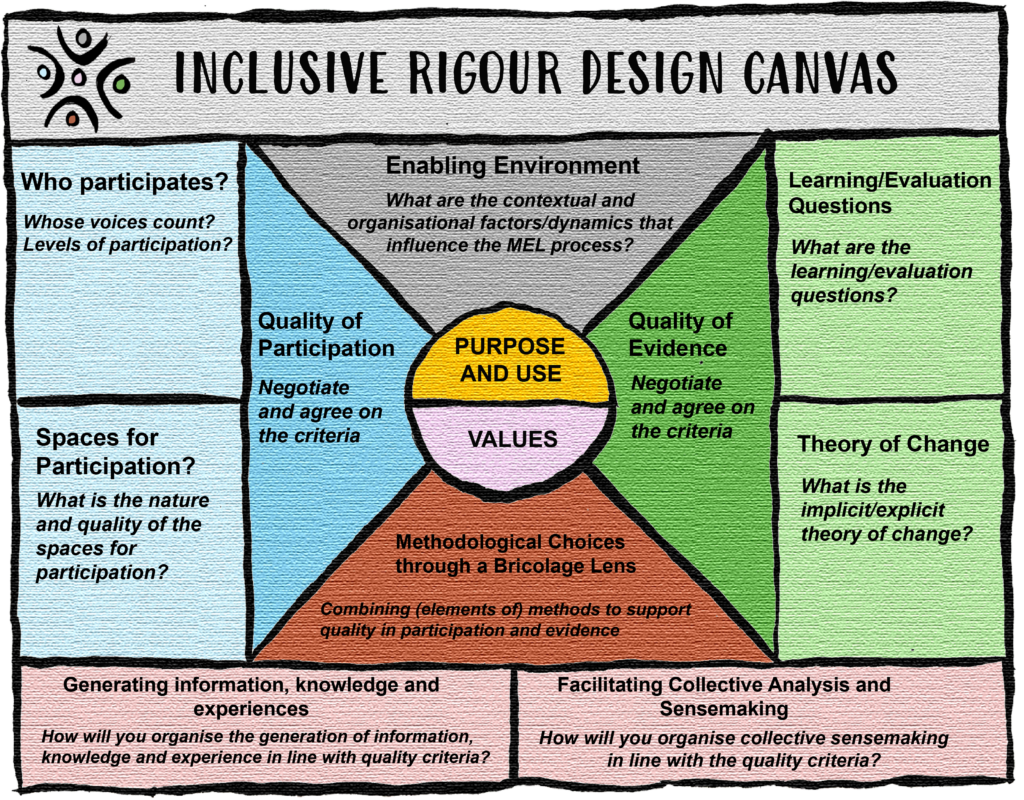
The Canvas can be used by a small core team as a practical design tool, but it can also support a broader participatory design workshop involving multiple stakeholders. In both cases, its purpose is to provide hands-on guidance for being more intentional, reflective and deliberate about Inclusive Rigour in MEL.
Access the Canvas
The Co-Lab wants to maintain a learning-focused dialogue with individuals and organisations using the Canvas. The Canvas and workbook are available for free – you only need to fill in the form below and the resources will be automatically sent to you, including English, French, Spanish and Portuguese versions.
Mini case study
This mini case study aims to showcase the value of using the conceptualisation of inclusive rigour to critically reflect on quality in a complexity-aware MEL design and process.
We use, the ‘Vestibule of Peace’ project, which was implemented between 2019 – 2024 and responded to the critical failure to meaningfully include local communities in the Malian peace process, as it was one of the original inclusive rigour cases that IDS was involved in.
It was co-designed and implemented by a Consortium of four partner organisations: (1) L’Institut Malien de Recherche Action pour la Paix (IMRAP), (2) Interpeace, (3) IDS, who played a methodological accompaniment role and (3) Humanity United (HU) whose peacebuilding strategy centred on building local agency as a vehicle to transform the peacebuilding system. The collaboration used Systemic Action Research (SAR) as an alternative to the conventional externally driven conflict management mechanisms which had revealed their limits through the 2012 crisis in Mali.
As is described by Apgar and colleagues (2024) the programme’s MEL system responded to the opportunity of developing and testing SAR as a dynamic and evolving methodology to locally owned and driven peace. It was co-designed by all Consortium partners with two objectives: (i) to facilitate actionable learning as the SAR process was implemented in order to fuel adaptive management; and (ii) to generate credible evidence and respond to agreed evaluation and learning questions. The evaluation design was based on a combination of contribution analysis with causal theories of change which were then explored through participatory process evaluation (via case studies), and outcome harvesting for causal analysis of emergent pathways.
The overarching evaluation question for the programme defined by the theory of change was: How does the SAR process at community level contribute to building the conditions for community driven peacebuilding? Within this, we focused on learning about the action research groups, asking what outcomes emerge directly through the action research group process for whom and under what conditions? We also were interested in understanding what broader processes of change result from the SAR process in local conflict resolution?
Using the inclusive rigour framework we here critically reflect on if and how the bricolage design supported meaningful participation. Through the SAR intervention itself, participants were involved in developing their own actions and evaluating their effectiveness. This grounding of the MEL design in the participatory intervention supported deepening participation, including use of local harvested for collection of outcome descriptions in the participatory outcome harvesting process. However, analysis remained in the control of the programme implementation team, missing an opportunity to support greater ownership and use of the evaluation findings by local communities. The design was intentionally aiming to support adaptive management, and emergent learning was used by the implementation team throughout. It was not, however, till the final evaluation was completed, and analysis that reflects back on the theory of change, that use beyond the internal programme needs becomes possible.
The main learning from this analysis was around the tensions held by different partners on the purpose of evaluation which created at times a disabling environment for the participatory evaluation. Some partners held on to views of evaluation as serving performance monitoring and struggled with a MEL design that was not business-as-usual.