This blog was written by Steff Deprez from the Inclusive Rigour Co-Lab and Voices That Count.
In 2022, a group of us gathered in Copenhagen to develop a richer understanding of Inclusive Rigour, drawing on the work of Chambers, Preskill and Lynn and others. The group of MEL practitioners, researchers and funders, mainly linked to peacebuilding programmes supported by Humanity United, first shared these emerging ideas at the European Evaluation Society Conference.
Rather than presenting a finished product, we shared insights from a year of practice, from community-led peacebuilding in Mali, to systemic action research in Colombia, to supporting young peacebuilding leaders in South Sudan. These ideas were captured in an early Inclusive Rigour Framework, highlighting methodological bricolage and iterative design as central to MEL processes that are learning-oriented, context-responsive and attentive to diverse voices.
Over the following year, the group continued to refine its thinking online. In November 2023, the group convened in Bogotá to further develop the framework, share cases and explore next steps. This gathering marked the beginning of the Inclusive Rigour Co-Lab.
The need for practical guidance
It was during the Bogotá meeting that we started to discuss the need for practical guidance that could help people translate Inclusive Rigour principles into practice. A first version of this guidance was developed and tested during the IDS Short Course on Participatory Monitoring and Evaluation for Learning, which Marina Apgar and I organise on an annual basis.
For the May 2024 course in Siem Reap, Cambodia, we adapted our existing seven-step approach to designing a participatory MEL process into an extended ten-step version that incorporated our emerging thinking on Inclusive Rigour. Participants used these steps to frame the design of their own cases. While the approach worked well, and participants experienced it as useful, we felt that a step-by-step format did not fully reflect the type of design process we had in mind.
Soon after, we made two important decisions that helped move the guidance forward.
The first decision was to work with a canvas rather than a sequential step model. A canvas does not prescribe a fixed order. Instead, it provides a way to navigate across different but interconnected domains, each supported by guiding questions. It can be entered and used in different ways, depending on the context and the purpose of the conversation. It also allows users to see all domains at once. This matters because discussions and decisions in one part of a MEL design process inevitably affect other parts. The canvas format therefore better supports the organic, iterative and back-and-forth nature of designing a MEL system.
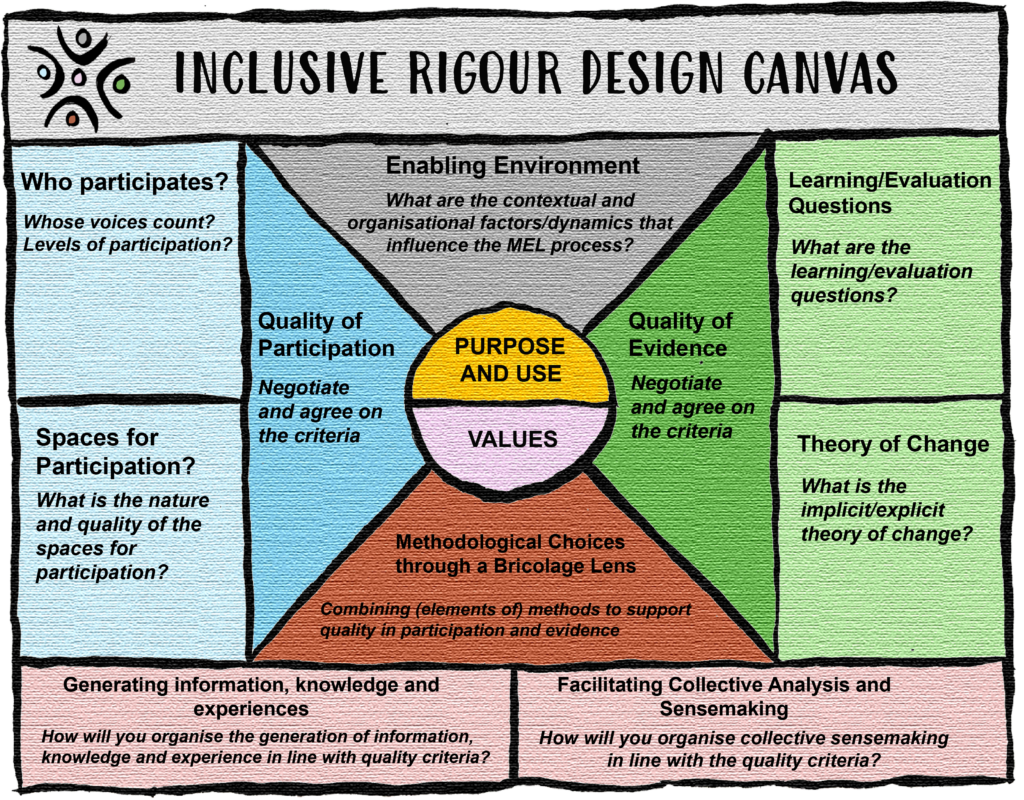
The second decision was to structure the practical guidance around two central dimensions: quality of participation and quality of evidence. This was in line with the argument developed in our journal article, Rethinking rigour to embrace complexity in peacebuilding evaluation (Apgar et al., 2024). These two dimensions became the backbone of the Canvas.
Testing and refining the Canvas
Based on this thinking, different iterations of the Canvas and its associated questions were developed. By June 2025, the Co-Lab gathered for a second time, this time in Senegal, where we tested a first full version of the Canvas. Working with three real cases, different groups moved through the domains of the Canvas, guided by a set of question cards for each domain.
This real-case test helped us sharpen the structure of the Canvas and refine the questions. One of the insights that emerged was that the three layers of the Canvas worked well. They suggested an iterative navigation process, moving from the centre of the Canvas towards the outer layers.
During the pilot, different ways of using the Canvas also started to emerge:
- using the Canvas in a group setting, with a large printed version and a set of cards to guide the discussion;
- creating an associated workbook, in hard copy or digital format, that includes all guiding questions and allows users to document the main outputs of their conversations;
- developing a digital Miro version to facilitate online discussions, while keeping notes and reflections visible and accessible to all participants.
The idea of the workbook was further developed for the next iteration of the IDS Course on Participatory Monitoring and Evaluation in Belgrade in September 2025. The workbook was integrated into the course as both a guidance document and a note-taking resource, supporting participants in designing the MEL process for their own cases.
Participants used the workbook throughout the course and welcomed it positively. Their feedback provided another important round of critical reflection and refinement.
Meanwhile, the Inclusive Rigour Canvas and workbook were presented in different events, webinars and trainings, including within the Learning Lab of the Outcome Mapping Learning Community (December 2025) and the Philea MEL Community of Practice (February 2026). Several MEL practitioners, projects and organisations have since used the Canvas, either fully or partially, to support the design or review of their MEL processes.
Making the Canvas and workbook public
Now we are ready to share the Canvas and workbook more widely, hoping that these resources will support people and organisations to think intentionally about Inclusive Rigour principles in MEL processes. We want them to help demystify the idea of Inclusive Rigour and translate it into concrete design choices, practical questions and collective conversations.
It is an invitation to engage in deliberate negotiation around two essential dimensions of Inclusive Rigour: the quality of participation and the quality of evidence. It supports the design of MEL processes that are fit for context, responsive to complexity, and attentive to equity and power dynamics.
In this sense, the Canvas functions both as a thinking guide and a conversation guide. It helps clarify assumptions, align expectations, build shared understanding and strengthen collective commitment to high-quality MEL practices. It encourages those involved to be explicit about their purpose, values, contextual constraints, equity orientation, and expectations around participation and evidence.
Who can use the Inclusive Rigour Canvas and workbook?
The Canvas and workbook can be used by different actors involved in MEL design, implementation, commissioning and review. This includes:
- Evaluators designing an evaluation process;
- Projects or organisations designing or improving their MEL process;
- MEL consultants supporting the development of MEL systems;
- Evaluation commissioners who want to integrate Inclusive Rigour principles into evaluation Terms of Reference;
- Funders who want to negotiate Inclusive Rigour principles in the MEL processes of grantees;
- Organisations developing portfolio-level MEL approaches;
- Teams reviewing or assessing existing MEL systems through an Inclusive Rigour lens.
Ultimately, the Canvas is not intended to provide definitive answers. Its value lies in helping people ask better questions, make design choices more explicit, and negotiate what quality means in a particular MEL process, with particular people, in a particular context.
As we write in the workbook:
“What you will find in this Workbook is not a rigid step-by-step guide or checklist. Rather, it offers a flexible framework that supports critical reflection and dialogue in design decision-making. Its value lies in helping you to adapt Inclusive Rigour concepts to your specific context in ways that are both practical and meaningful to you.”
Access the Design Canvas and workbook
The Inclusive Rigour Co-Lab uses circles of action, reflection and learning to engage with actors in the global evaluation ecosystem. Therefore, the Co-Lab wants to maintain a learning-focused dialogue with individuals and organisations using the Canvas. The Canvas and workbook (PDF and Miro version) are available for free – you only need to fill in the form below and the resources will be automatically sent to you, including English, French, Spanish and Portuguese versions.
We may contact you to discuss how you have been using the Canvas and to answer any questions you may have. You won’t be signed up to any newsletters. Please also connect with us on LinkedIn to join the conversation.